

PE laminated paper and PLA laminated paper are both widely discussed in food packaging and paper converting, but they are not interchangeable materials. In most packaging applications, PE laminated paper is usually the more practical option for heat resistance, sealing stability, cost control, and supply consistency. PLA laminated paper may be a suitable alternative for certain cold-use applications, especially where industrial composting systems and certified disposal pathways are available.
For engineers, converters, and procurement teams, the real difference is not just “plastic vs bio-based.” It is about material behavior, processing tolerance, end-use performance, and end-of-life reality. This article compares PE vs PLA laminated paper from a technical and sourcing perspective, so packaging buyers can make decisions based on performance rather than marketing claims.
Quick Verdict
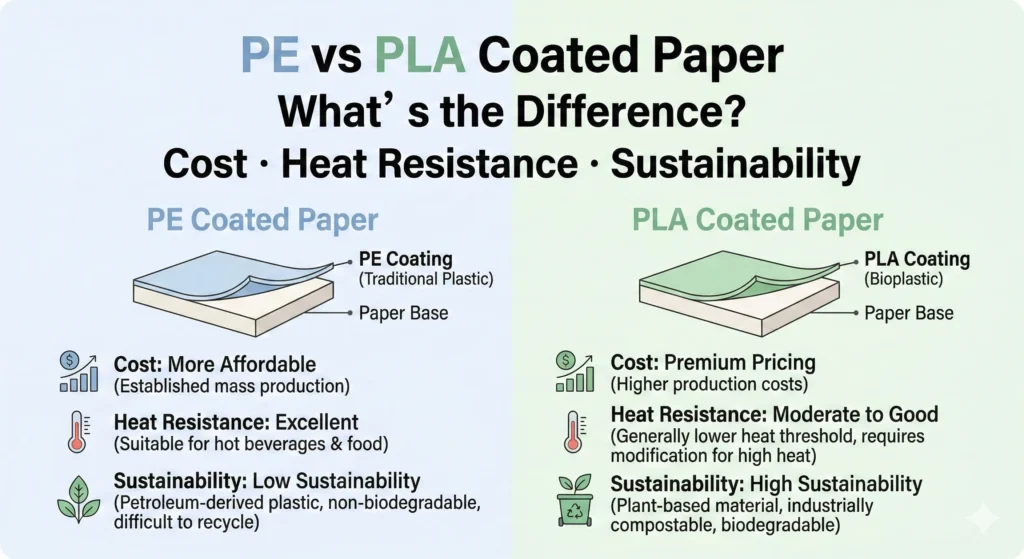
If the priority is cost efficiency, broad process compatibility, and stable sealing performance, PE laminated paper is generally the better choice. If the priority is bio-based material positioning and the package is intended for cold-use applications within an industrial composting system, PLA laminated paper may be worth evaluating.
Here is the short version by scenario:
· Hot drink cups or warm food packaging → PE is usually more reliable
· Cold beverage cups → PE or PLA may both work, depending on sealing and disposal needs
· High-speed production lines → PE is easier to process because it has a wider heat seal window
· Cost-sensitive packaging → PE is usually lower cost
· Sustainability-driven projects → PLA may be considered, but only if composting infrastructure exists
In other words, the right material depends on the application. There is no universal winner.
Material Comparison
Although both materials can be laminated onto paper, their polymer properties are quite different.
Density and Structure
PE, especially LDPE, has a softer and more flexible molecular structure. This gives it better flexibility and better tolerance in folding, sealing, and forming operations.
PLA has a higher rigidity and a stiffer feel. In some paper packaging structures, this can be helpful for shape retention, but it can also increase brittleness.
Melting and Softening Behavior
PE softens at lower temperatures and provides reliable thermal bonding across a broad process window. This makes it easier to use in mass production where machine settings can vary slightly.
PLA can also be sealed thermally, but its process window is often narrower. It is more sensitive to temperature, dwell time, and pressure. If conditions are not properly controlled, the result may be weak or brittle seals.
Brittleness and Crack Resistance
One of the most practical differences is brittleness. PE is more forgiving in converting processes. PLA is more likely to crack or fracture under stress, especially in folded, creased, or low-temperature conditions.
Low-Temperature Performance
PE generally maintains flexibility better in cold environments. PLA can become more brittle at low temperatures, which is an important consideration for refrigerated or cold-chain packaging.
Packaging Performance
For packaging buyers, material comparison only matters if it leads to reliable real-world performance.
Water Resistance
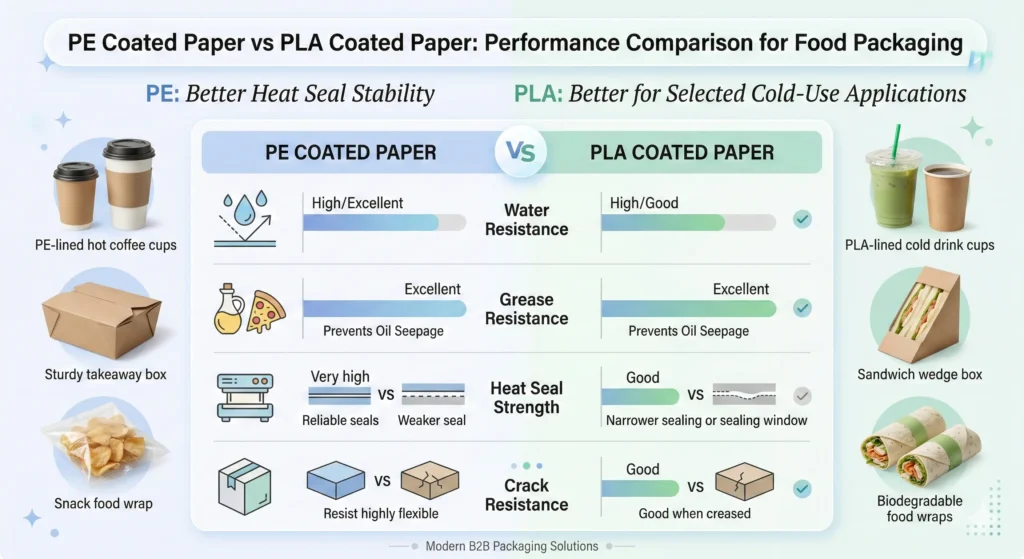
Both PE and PLA laminated paper provide moisture resistance, but PE usually offers more stable water barrier performance over time. This is especially relevant when the package is exposed to humid conditions, condensation, or warm liquid contents.
Oil and Grease Resistance
PE has a longer history in grease-resistant food packaging and is widely used in takeaway packaging, liners, and food service products. PLA can provide useful resistance in some structures, but performance depends more heavily on coating thickness and application design.
Heat Seal Strength
PE laminated paper is usually easier to seal consistently. It tends to offer stronger and more forgiving seals across a wider operating range.
PLA laminated paper can achieve acceptable heat sealing, but it typically requires tighter process control. On high-speed lines, this may increase operational risk if the process is not optimized.
Resistance to Cracking
For cartons, lids, or formed packaging structures, PE laminated paper generally performs better against cracking and coating breakage. PLA may need more careful structural design to avoid problems during folding or forming.
Sustainability Reality Check
This is where many comparisons become oversimplified. Neither material should be called “better” without considering the local waste system and full package structure.
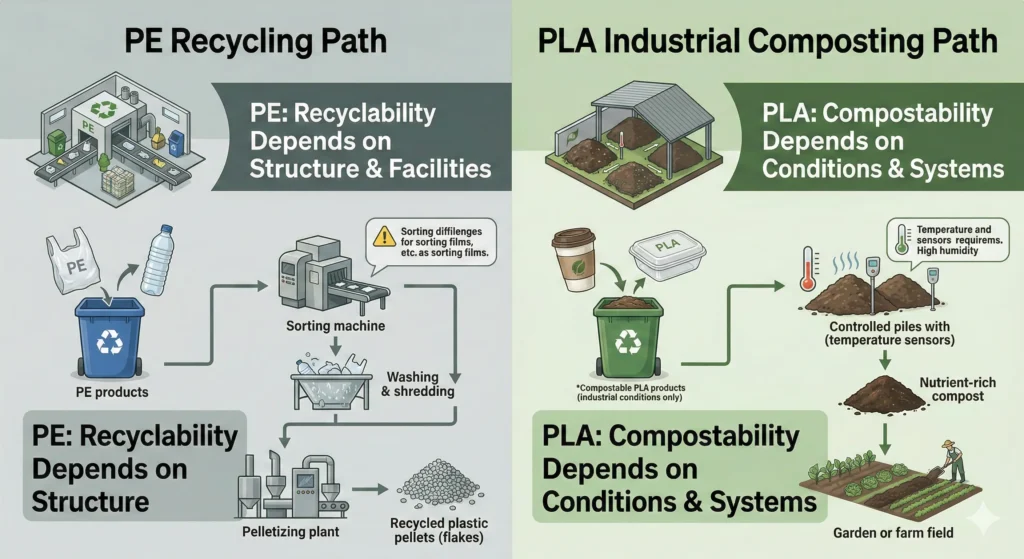
PE: Recyclability Depends on Structure and Facilities
PE laminated paper may be recyclable in some systems, but actual recyclability depends on:
- coating thickness
- paper-to-polymer ratio
- repulpability
- local recycling infrastructure
In many markets, laminated paper is still difficult to recycle at scale. So while PE may be recyclable in theory, the real-world outcome depends on the system available.
PLA: Compostability Depends on Conditions and Access
PLA is often marketed as compostable, but this is only true under industrial composting conditions and for appropriately certified structures. PLA laminated paper is generally not suitable for home composting unless specifically certified for that use.
More importantly, compostability is only meaningful when a local collection and treatment system exists. If the package enters a waste stream without industrial composting access, the environmental benefit may not be realized.
For this reason, procurement teams should treat both recyclability and compostability as system-dependent, not just material-dependent.
How to Choose
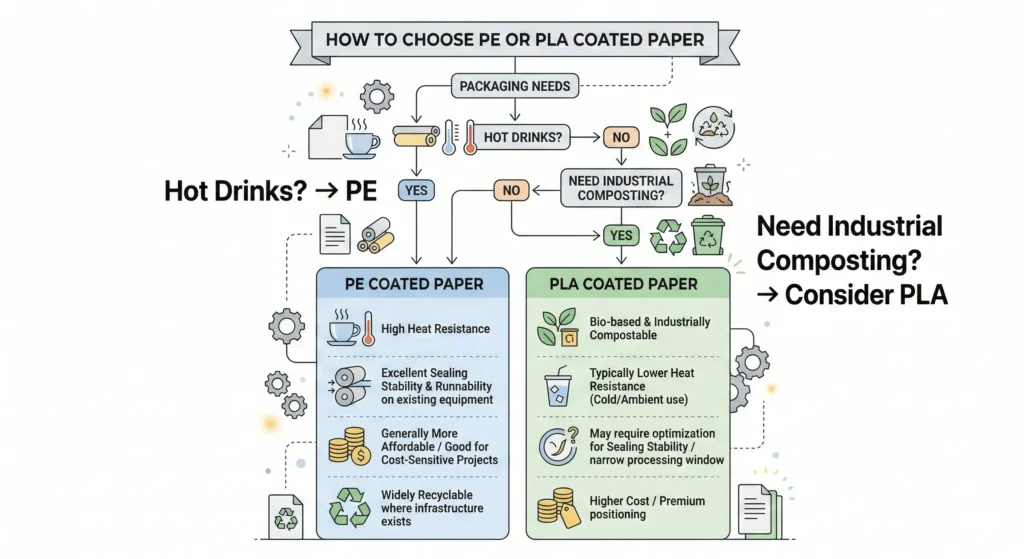
Is the package used for hot drinks or elevated temperatures?
If yes, prioritize heat resistance and seal stability. In most cases, PE laminated paper is the safer choice.
Is industrial composting available in the target market?
If yes, and the package is intended for cold-use conditions, PLA may be worth considering.
Is the packaging line high speed?
If yes, PE usually offers better process stability due to its wider seal window.
Is the project highly cost-sensitive?
If yes, PE is usually more economical and easier to source consistently.
Is the package being selected mainly for sustainability messaging?
If yes, verify whether the disposal route actually matches the claim. A compostable structure without a composting system can create confusion rather than value.
The best approach is to start with the real application: temperature, sealing requirements, logistics, compliance, and disposal conditions.
FAQ
Is PLA laminated paper better than PE?
Not always. PLA may be useful in specific cold-use applications, but PE usually performs better in heat resistance, seal consistency, and cost.
Can PLA laminated paper be used for hot drinks?
In most standard structures, PLA is less suitable for hot drink applications. It has more limited heat tolerance than PE.
Is PE laminated paper recyclable?
Sometimes. It depends on the coating structure and whether local recycling facilities can process laminated paper.
Is PLA laminated paper compostable at home?
Usually no. Most PLA-based packaging requires industrial composting conditions unless it has specific home-compost certification.
Which is cheaper, PE or PLA laminated paper?
PE laminated paper is generally lower cost because PE resin supply is more mature and widely available.
What is the best laminated paper for food packaging?
That depends on the application. For hot-fill, heat sealing, and broad process compatibility, PE is often the better choice. For selected cold-use applications with composting access, PLA may be considered.
Conclusion
PE vs PLA laminated paper is not a simple sustainability debate. It is a material selection question that should be evaluated based on performance, process stability, cost, and end-of-life reality.
For most mainstream food packaging applications, PE laminated paper remains the more practical and reliable choice. PLA laminated paper can make sense in certain cold-use packaging systems, but only when the application requirements and local composting infrastructure are clearly aligned.
For engineers and procurement professionals, the most trustworthy decision is not the one with the strongest marketing claim. It is the one that matches the actual use case.